What is Heiwa Matsuri?
Heiwa Matsuri was born out of respect for the “Sapeurs.”
The Sapeurs are active in the Republic of the Congo and the Democratic Republic of the Congo — among the world’s poorest nations, where conflict continues to this day.
They dress in colorful, high-end suits, and live by the belief: “We never fight, because we never want to stain our clothes.” Through this, they send a message of world peace.
Moved by their activity, we wanted to send a message of “peace” from Japan as well — and so Heiwa Matsuri was born.
We adopted the concept: “The Attire of Peace = Kimono,” “We never stain kimono, so we never fight.”
We designed this project so that people across Japan — and eventually the world — could wear kimono as a symbol of peace, and send a message of “peace” to the world.
Interview with the Founder
Read the Founder’s Message & Profile →
What Heiwa Matsuri Aims to Achieve
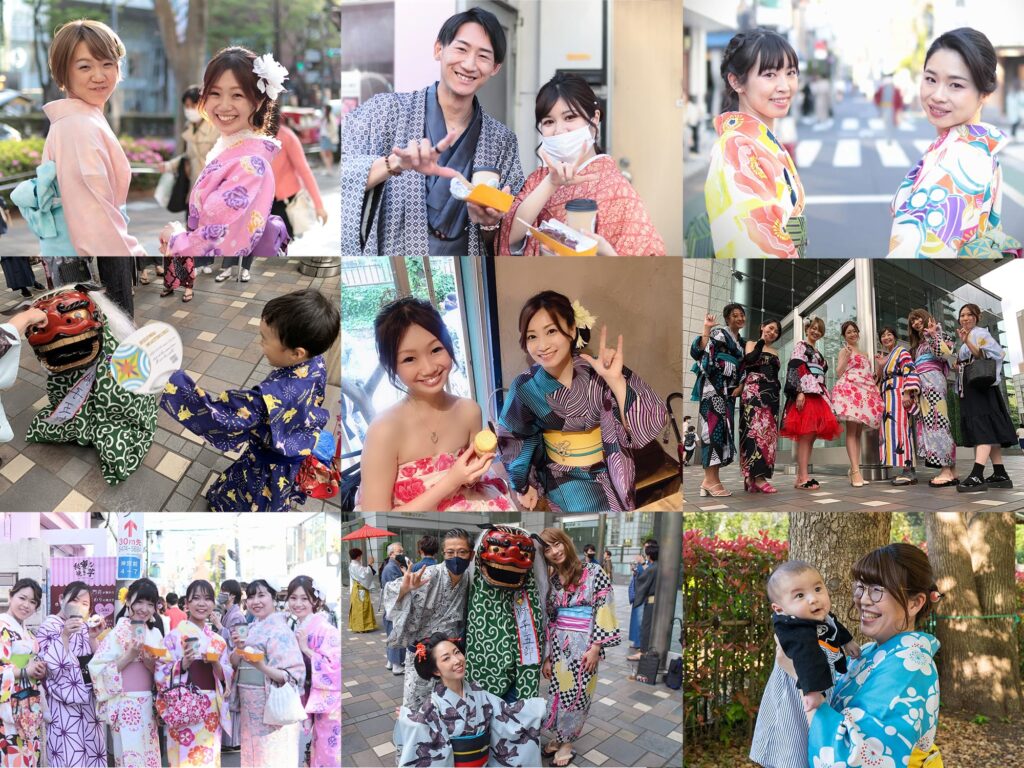
By making Heiwa Matsuri an annual event held around the world, we create opportunities for people everywhere to think about “peace.”
We aim to make September 21, the International Day of Peace, a public holiday, and to make “HEIWA” a universal word. We are working, as quickly as possible, to create a day that people all over the world look forward to.
The Meaning Behind Our Logo
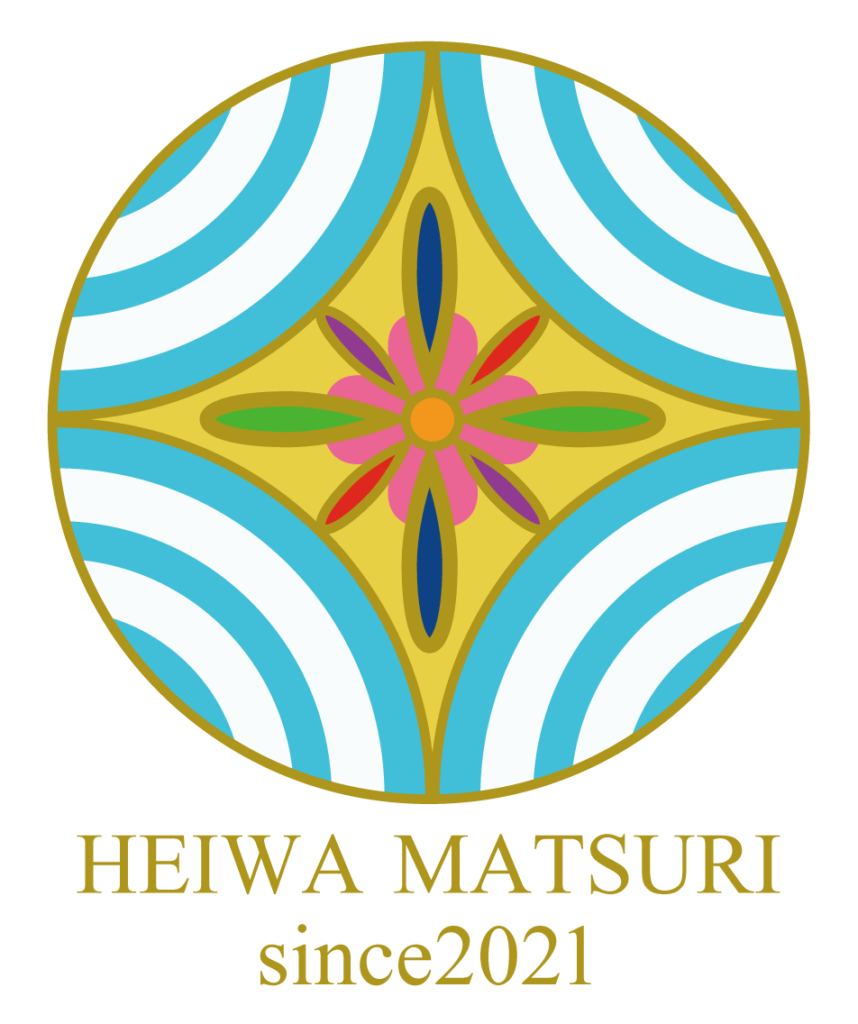
The “HEIWA MATSURI” logo is designed from traditional Japanese patterns and auspicious motifs — seigaiha (blue ocean waves), shippo (seven treasures), hanabishi (flower diamond), hishimon (diamond pattern), and floral patterns — layered with the meanings of the dawn of the world, fireworks, cherry blossoms, and the four-leaf clover.
Just as the name “HEIWA MATSURI” suggests, this logo carries a forward-looking message: not merely wishing for peace, but a festival where people rejoice together and celebrate a world in which peace has arrived.
Seigaiha — A Wish for Peace That Lasts Forever
The connected light-blue and white semicircles spreading around the outer edge represent the Japanese pattern known as seigaiha.
Evoking gentle waves that continue on endlessly, seigaiha is an auspicious motif expressing the wish that peaceful living may continue for all eternity, and that serene days may last far into the future.
In this logo, the seigaiha is arranged so that it spreads in all four directions, expressing how waves of peace spread outward — not only across Japan, but in every direction across the world.
Shippo — Bonds Between People, and Between Nations
The circular composition, and the overall impression of rounded forms overlapping one another, also evokes the shippo pattern.
Shippo is a motif of circles connecting one after another, symbolizing harmony, accord, fateful encounters, and the bonds between people.
Because the logo as a whole is circular and expands evenly from the center in every direction, it holds a wish for a world in which person and person, nation and nation, culture and culture are bound together in harmony.
Hanabishi and Hishimon — Hope and Prosperity Spreading in All Directions
The shapes extending from the center upward, downward, left and right carry the impression of hanabishi and hishimon.
Hanabishi, a flower stylized into a diamond shape, evokes dignity, prosperity, beauty, and blessing.
Hishimon, in turn, can be read as a motif symbolizing strong vitality and expansion.
In this logo, because the shapes extend outward from the flower at the center, they express the wish for peace spreading north, south, east and west, and hope for the future reaching out into the world.
Cherry Blossoms and the Four-Leaf Clover — The Heart of Japan, Good Fortune, and the Flower of Peace
The flower at the center can be read as a cherry blossom.
The cherry blossom is a flower that symbolizes Japan, representing spring, renewal, new beginnings, and the beauty of life.
The cherry blossom in the Heiwa Matsuri logo is not merely an expression of Japanese-ness. It is placed there as a flower that carries a wish for peace out to the world, from a Japanese heart that knows the preciousness of life.
The shape of this cherry blossom also carries the meaning of a four-leaf clover.
The four-leaf clover is a symbol of good fortune, hope, happiness, and blessing.
By bringing together the gentle Japanese spirit of the cherry blossom and the wish for good fortune held in the four-leaf clover, it expresses happiness and the wish for peace reaching the four corners of the world.
And the cherry blossom holds one more important meaning.
In Japan there is the scenery of senbonzakura — a thousand cherry trees blooming all at once.
The sight of not one tree alone, but thousands of blossoms blooming together, symbolizes how the wish for peace held by each individual gathers to become a vast landscape of hope.
In many countries and regions around the world, including Japan, people plant flowers and trees after wars and conflicts have ended, as if to heal the land that was lost and the hearts of the people.
The act of planting flowers is a mark of peace that carries renewal and prayer into the future, beyond sorrow.
The cherry blossom in this logo is also a flower of peace that blooms after conflict.
It holds the wish not to forget the past, but to cherish life and to hope for a world where beautiful flowers bloom once again.
Fireworks — Remembrance, Celebration, and a Sky Without Borders
The flower shape radiating out from the center also overlaps with fireworks opening in the night sky.
Fireworks are a symbol of festivals, representing joy, prayer, blessing, and the sense of unity felt when people look up at the same sky together.
At the same time, these fireworks carry a prayer of remembrance for the lives lost and the people wounded by conflicts of the past.
The light of fireworks, blooming quietly in the night sky and then fading away, is a light that mourns those who have died and reflects on past sorrow, while carrying the wish for peace on into the future.
Moreover, the sky into which fireworks rise has no borders.
Even though there are lines on the ground dividing countries and regions, the sky is connected as one.
When people look up at fireworks blooming in that same sky, they can share the same beauty and the same wish, transcending nationality, culture, and position.
Furthermore, the fireworks in this logo carry another important meaning: the peaceful use of gunpowder.
Gunpowder is, in its origins, a force that has also been used for conflict and destruction.
In fireworks, however, that same force is used not to harm people, but to color the night sky, to bring smiles to people’s faces, and to celebrate peace.
In other words, fireworks are a symbol of transforming the power of destruction into a light of blessing — using gunpowder not as fire for conflict, but as light that prays for peace. It is a profound message befitting Heiwa Matsuri.
These fireworks hold
remembrance for the past,
the joy of celebrating together in the present,
and a prayer for future peace, sent up into a sky without borders.
The Dawn of the World — The Beginning of an Era of Peace
The light-blue and white seigaiha, together with the golden light spreading from the center, give the impression of the morning sun rising from beyond the sea.
This expresses the night of conflict and division giving way to dawn, and a new morning of peace arriving in the world.
Because the cherry blossom and the fireworks at the center open like the rising sun, peace is expressed not as a distant ideal, but as a new era that begins through the prayers and actions of people.
The Overall Concept
This logo is a mark that layers within a single circle the serenity of seigaiha, the harmony of shippo, the prosperity of hanabishi and hishimon, the life of the cherry blossom, the good fortune of the four-leaf clover, the hope of senbonzakura, and the remembrance and celebration of fireworks.
The fireworks in particular carry remembrance for the lives lost in past conflicts, the “peaceful use” of gunpowder — for celebration that brings smiles to people, rather than for war and destruction, and the sending up of a wish for peace into a sky without borders.
The cherry blossom, too, carries not only the beauty of Japan, but the wish that many prayers may gather like senbonzakura to create a landscape of peace, and that flowers may be planted after war and conflict, carrying renewal and prayer into the future.
This logo mark as a whole expresses
“a festival that spreads the prayer for peace embodied in Japan’s auspicious patterns as a dawn for the world — transforming even the power of destruction into a light of blessing, honoring the memory of past conflicts, and celebrating the happiness and harmony of people under a sky without borders.”
HEIWA MATSURI is a festival that inherits the prayers embodied in Japan’s traditional patterns while, together with people all over the world, wishing for peace, celebrating peace, and carrying peace into the future.